Saturday, September 16, 12023 Human Era (HE)
This is a continuation of a previous post. For part one of “Words on the Whey-ah-wichen Whipper” click here.
Physical Prep Physiology
As the scheduled race time approached, I decided to start warming up. There were many participants around who were going through their various paddle preparations. Mine started with some gentle upper extremity motions before evolving into what is now my traditional movement preparation routine. The physiological benefits of a warm-up are profound for physical activity preparation, though the jury is still out on one of the most important proposed benefits, injury prevention.
Warming Up for the Whey-ah-wichen Whipper
Many of the benefits of warming up are literal. The body’s physiology changes with the elevated temperature that accompanies the mechanical heat release from muscle contractions in ways that benefit physical exertion.
Moving Muscles
The activation of muscles during a warm-up is of reciprocal benefit. Contracting muscles release heat, and the increase in temperature improves muscle contraction speed (i.e., the rate of force development of a muscle twitch) and maximum tetanic force development.
Not Just the Heat: Non Thermal Muscle Effects of Warming-Up
Independent of the increase in muscle temperature, a warm-up can potentially increase performance by ‘pre-conditioning’ the muscle. Known as post-activation potentiation (PAP), a phenomenon in which the force exerted by a muscle can be increased after previous high(er)-intensity contractions. Post-activation potentiation theory suggests that the mechanical performance of a muscle can be improved with prior maximal or near-maximal contraction. The performance benefit is most advantageous in explosive activities, like sprinting, and has been utilized by athletes engaging in these sporting events whenever practically possible. Athletes must be careful to avoid fatigue when employing this strategy as fatiguing muscle contractions impair muscle performance, whereas non-fatiguing muscle contractions at high loads of a brief duration can enhance muscle performance.
Next Up: Nerves
Most people are familiar with the effects of cold temperatures on nerve function. Think about trying to complete a fine motor task like zipping up a zipper when your hands are cold. If cold enough, the task is nearly impossible. That incoordination of your hands is a result of reduced conduction velocity in your nerves and muscles. Increasing body temperature can improve conduction velocity and improved muscle function. But this is to a point, there is a Goldilocks zone. Too hot or too cold, and performance suffers, but if you get it (just) right, then you are a Baby bear, and your nerves function just right.
What exactly this magical temperature is, remains up for debate. It likely depends on intrinsic and extrinsic factors but lies somewhere north of resting temperature.
Cardio-Metabolic Contributions
The cardiovascular and metabolic effects of warm-up most cited are the effects that increased body temperature has on improving oxygen release from hemoglobin and myoglobin. Evidence also suggests that vasodilation that accompanies a warm-up may improve energy substrate delivery and metabolite removal (and even offset any transient ischaemic effects on the heart of high-intensity exercise). There is some mixed data that suggests warming up results in more ATP utilization that could be negative for prolonged exercise. However, in my opinion, I think the other benefits of a warm-up outweigh any minor change in long-term energy availability.
Injury Prevention: Ideals Versus Evidence
Warming up is often touted as a tool to avoid the torture of injury. While I am a believer that a warm-up can lower the risk of injury, the evidence pointing specifically at the warm-up, itself, is less robust. Though this could be argued either way, the absence of evidence is not evidence of absence. It could be that we have yet to observe solid evidence of the indisputable benefit of warm-up, or perhaps such benefit does not exist.
Possibilities
One area of muscle physiology that does not get that much mention is muscle thixotropy. Thixotropy is the phenomenon by which fluid viscosity can alter with mechanical agitation. Muscle thixotropy can be “described as a temporary reduction in the resistance of muscles to externally applied, or internally generated, movement.” Thus, at the mechanical level, the benefits of a warm-up would likely arise from the benefits of improving tissue viscosity.
(Don’t) Hold the Static Stretch
Personally, I am a fan of dynamic stretching pre-exercise and have practiced this for a long time. I will do static stretching post-exercise from time to time or more commonly as part of a general muscle, tendon, and joint health practice. With respect to performance, it has been shown that static stretching can negatively impact muscle strength and power development. However, more recent evidence suggests the negative effects are minimal and can be counteracted if the static stretching is part of a more comprehensive warm-up. I do support people doing static stretches as part of a warm-up if they feel particularly tight for a given movement as long as they do more general movements in their preparation as well.
But to be clear, the most important aspect of a warm-up in my mind is moving a little bit to bring up the body temperature to take advantage of the benefits that accompany this process.
Pre-Race Briefing
The pre-race briefing was called to order as I continued to prepare my body for the race with dynamic movements. They went over the course, starting order (sit down vessels to stand up, longer to shorter), and drafting rules. More on this to come, but my recollection was that it was legal to draft anyone competing in the same race as you (regardless of sex or gender). I took that to mean, same distance and same watercraft, drafting is okay. But in hindsight, I was quietly conversing in the back of the group with my racemates while I continued to warm-up and may have missed the true instructions.

On the Water
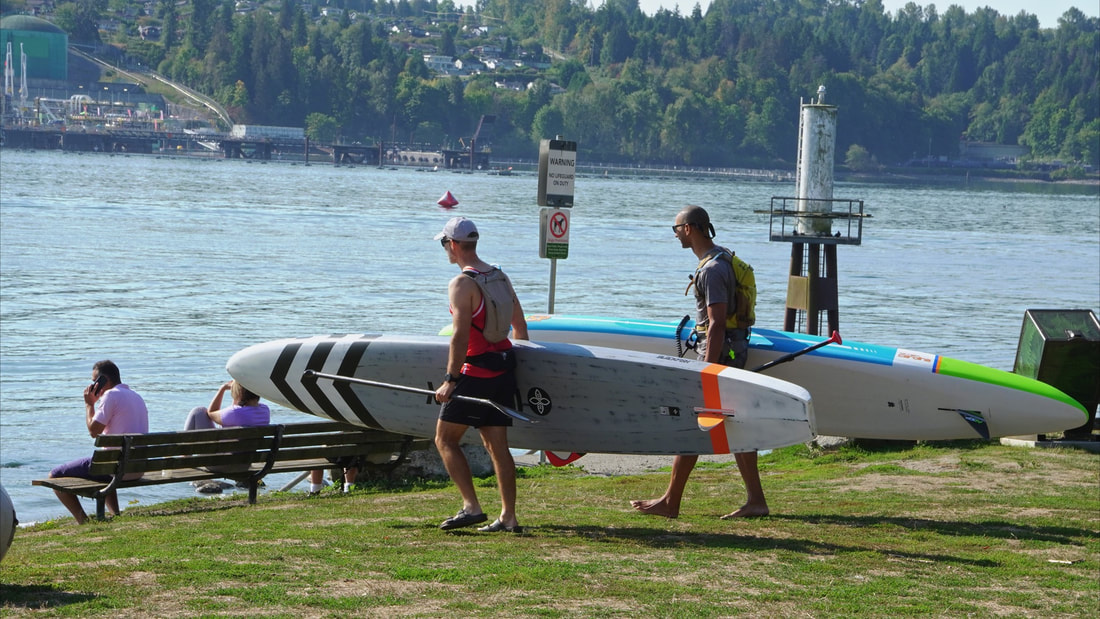
With the pre-race briefing wrapped up, I walked down to the water to warm-up in the way of the waiting work. A few back-and-forth lengths around the starting line with a specific focus on form as well as a few fast forays interspersed with step-back turns and even a few boat wake rides.
Then it was off to the start line at the starter’s warning.
 I SUP Explore
6 thoughts on “Words on the Whey-ah-wichen Whipper (2.0)”