Sunday, July 28, 12024 Human Era (HE)
- Vancouver SUP Challenge: Background
- Restock, Rest, Repeat
- Rest
- Too Brief for Debrief
- Let the Race Begin
- Solid Start
- Lap Two to Finish
- Final Thoughts
Vancouver SUP Challenge: Background
The Vancouver SUP Challenge is a one-day multi-distance paddleboard race extravaganza. Stand up and prone paddlers compete on both a five – and two-kilometre course for the cumulative best time. Additionally, there is a recreational inflatable board category as well as logball championships, rental boards available, sponsor tents, and live music.
The Lead Up
To read about the five-kilometre event earlier in the day, click here. For the two-kilometre technical/sprint style course continue to read on…
Race Day No Re-Course

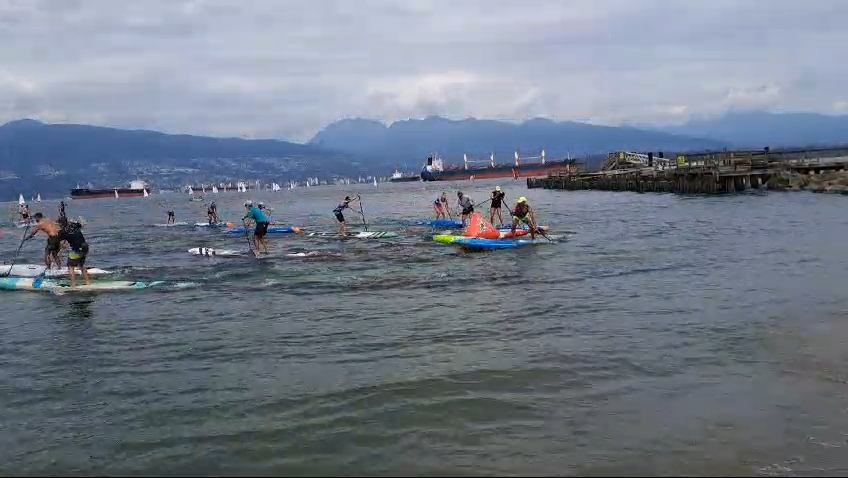
The event’s two-kilometre course is pictured above. The standard five and two-kilometre course routes are also available on the race website. Despite the non-seasonal weather/winds and change in course for the five-kilometre route, the two-kilometre course stayed the same. The technical/sprint-style circuit is a “V” shaped chicane, launching from west of the Jericho Pier and heading towards a floating buoy. Keeping the buoy on the port side for the first turn, paddlers then head back into shore to make a starboard turn at the near shore buoy before heading back out to another off-shore buoy for another port side turn. Next, contestants paddle into shore, dismount, and carry their board onto land and around an onshore buoy before re-entering the water for a second lap of the same course. The second lap completes with a dismount and run onto shore to touch the last inflatable buoy (the same one that was rounded on the first lap, but without the requirement to carry one’s board).
Restock, Rest, Repeat
After the five kilometre race, I debriefed with some spectators and other contestants before making my way over to the Jericho Sailing Centre for a pit stop. Then, I turned my focus to hydration, fuel, and rest.
Restock
It was a short window before the short course. I wanted to rehydrate and refuel since the race would be high-intensity. Proper hydration is key for athletic performance. Losing as little as 1% of your body weight affects physiology. Reductions of 2% of body weight are shown to be detrimental to performance, with 5% reductions demonstrating as much as a 30% reduction in work capacity.
Bet on Sweat
Previously, because I am a sports nerd, I did a simple practical test to estimate my sweat rate. Before that, in college, I recall doing a less controlled version where our coach had our basketball team weigh in pre- and post-practice. From memory, we failed to control for clothing sweat saturation as well as water consumption during practice. But his point was made. Many of us were losing large volumes of sweat and needed to be mindful of hydration.
Sweat Test 101
To do a basic sweat test, all you need is a reliable scale. Weigh yourself pre- and post-exertion of a known duration. The difference in weight in kilograms is essentially the loss of sweat in litres. To be most accurate, you need to account for sweat trapped in your clothing, so it is easiest to do your weigh-ins in the buff. Additionally, if you consume fluids during the exertion, you need to account for this in your calculation. Then, some simple maths to change the weight/sweat loss into an hourly rate for conventionality, and voilà, Bob’s your uncle [like you are Arthur Balfour of 11917 (HE) Balfour Declaration fame].
Temperature and humidity complicate the base rate. However, the test will give you a good ballpark number, from which you can plan hydration strategies. Typical human sweat rates range from 0.3 to 2.0 litres per hour. But some of the most extreme sweat rates reported are greater than four litres per hour! And you thought you were sweaty 😄.
Calculus
My sweat rate estimates have been approximately 1-1.5 litres per hour. Typically, I have made estimates from 30-minute tests extrapolated to one hour, so I suspect I’m closer to the lower end of that. For the five-kilometre event, I chose not to carry or consume any fluids during the race. Regardless of the sweat rate, this meant I would finish more dehydrated than I started. My plan was to rehydrate between the races.
Knowing my sweat rate and estimating my race time, I assumed my sweat loss from the five-kilometre race would likely affect my short course performance. Especially if I did not replenish adequately between events. I did not bother with any calculations on how much to drink, I just knew I needed to knock back some fluids post-race.
In hindsight, my sweat loss would have been approximately one litre given my race time. It is not quite hitting the mark of a 2% reduction in body weight, but I assume I would have continued to sweat post-race as my body worked to cool down and manage the outdoor heat. Furthermore, who knows what effect the outdoor ambient humidity had. I assumed I was sweating more outside than in. In the future, maybe I will do some practical field tests to estimate the effect of external environments.
In any case, during the rest interval, I consumed over a litre of fluid that was stocked with electrolytes and simple sugars in an attempt to minimize the dehydration damage. It is important to remember that you are losing sweat (or perspiration) and not just water. Sweat secreted from your eccrine sweat glands is mostly water but does contain trace amounts of dissolved minerals (the infamous electrolytes). It is more effective and efficient to replace sweat loss with a sweat-like solution rather than just pure water.
Hydration Resources
For an excellent exercise science resource on sweating and managing hydration, check out this video link on how to optimize hydration from Andy Galpin‘s website. Or this video from the Institute of Human Anatomy on the effects of sweating too much.
Refuel
There is approximately a 30-minute window post-activity that is ideal for nutrition consumption. Most of the time, this window matters little and is overhyped for the general exercise enthusiasts (myself included). There is ample time between exertion bouts for the body to restock and/or the stores are not depleted enough to require replenishment. However, where the window can matter is when the intensities are higher and the recovery time is shorter. It may be my sportsman hubris, but I felt I was meeting those marks in this window.
It is worth noting, however, that in this particular case, the turnaround time between events was so short that it would not allow for the full digestion and absorption of much of the nutrients I ingested. Despite this, my goal was to minimize the damage and offset my blood glucose levels as much as possible. I probably would not reconstitute much, if any, glycogen, but I may limit further loss.
Carbs, Fats, Proteins
Between events, I forced down some granola bars, a peanut butter and jam sandwich, and fruit to help with my recovery. Thankfully, food consumption for me pre-exercise does not result in gastrointestinal distress. My trouble is that I am not immediately hungry after exercising.
Rest
When I had first arrived on site, I had placed my bag underneath the corner of an event tent that I assumed was there for shading. It turned out it was there for shading, obviously, but was not a general event tent. Upon return, I realized the tent was a team tent for Deep Cove Kayak athletes, not a general Vancouver SUP Challenge tent as l had assumed . No one from the Deep Cove crew seemed to mind my blunder or presence, but I felt awkward about it, so I grabbed my kit and found a shady seat in the shadow of the undersea cable sign. My plan was to get some rest and stay cool before starting to warm up for the short course.
However, between the short transition time, chatting with race mates, and the arrival on my extending family visiting from Belgium to the beach, the rest window flew by.
Too Brief for Debrief
But before I knew it, the two-kilometre pre-race meeting was upon us. I had just made my way down to the water to start warming up when the call was made for the race meeting. Worried that I would miss out on any route revisions, I changed course from toward the water to warm-up and tuned into the tip-off.
When I realized that the short course would remain the same, I cut out early to get on the water. But as luck would have it, there was no time to warm up. The brief broke, and the riders made their way to their rides and the start line. I managed to get a few strokes and a step-back turn in before things on the start line looked like it was race time. I managed to squeeze in a spot well west of the pier.
Leash or Not
One dilemma that came up during the pre-race meeting was what to do about my leash. Given that we were close to shore and would need to dismount, leashes were not required by the race organizers. However, I have conditioned myself to always were my leash, so to not wear it felt like a violation of my safety rules. Also, given that I typically attach my leash to a waist belt, I did not foresee it being a hindrance during the beach run. Lastly, I worried that chaotic capsize on a corner with a leash might make board retrieval complicated (those I also entertained leash employment involving entanglement in the event of an erratic ejection). In the end, I chose to sport a leash.
Let the Race Begin
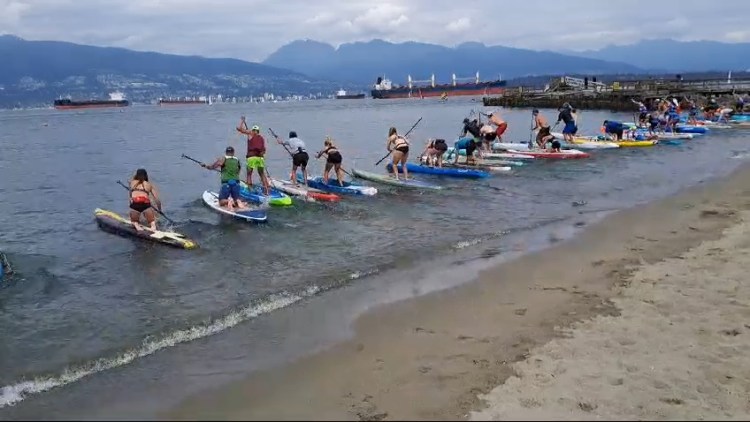
Similar to the five-kilometre race, the two kilometre course started en masse. Again, with a beach start minus the run-in.
However, this time, I was ready for the call. I was not going to be caught off guard a second time. With a long line of racers and my later arrival to the start line, my westward position left me with a less optimal approach angle. In hindsight, I failed to consider start line positioning. Upon reflection, a closer position to the pier for a straighter line to the first turn would be ideal. Ah, well, race and learn. Though truth be told, my position was not the problem for podium placement. My predicament was my paddling pace presenting as a palisade.
Solid Start
I was up onto my board quickly (I think). I attribute this to my practice session the day before as well as a general practice of board mounts since I tend to fall in frequently. The video below is the short course start courtesy of my ‘cousin-in-law’ (technically the “husband of my paternal first cousin” according to my Ancestry.ca family tree).
My goal was to get to the first turn in reasonable position to avoid any collision carnage. I feel like my pivot turns are decent, so I wanted to take advantage of a strength. I was not completely in the clear at the turn and had to turn wider than wanted, but I managed to avoid chaos and capsizing. Both wins.
The field spread out after the first turn (at least my section), making for a more manageable inland turn. Though, as I approached the turn, I wondered how shallower water would interplay with wash turbulence. As luck would have it, I was more or less alone for the turn with adequate space and not feeling rushed. I made extra effort to get low for better balance for my step back turn.
The third turn was much the same. Though the turbulence in the water was greater as we were no longer in the lee of the pier. I worked hard to keep my turn tight and stick to the port side.
Heading into shore, I was clustered among riders and tried to push to gain some ground. I do not recall an explicit pass leading into the beach run, but as my cohort re-entered the water, I saw two racers just ahead of me collide and capsize. It sucks to see something like that happen to slow someone down, but that is nature of the sport. I will confess that I was selfishly happy to advance two places.
Lap Two to Finish
Lap two was much of the same. I went a bit wider than wanted at the first buoy, despite having room to manoeuvre. The same held true for the inland turn. Ironically, the calmer water with fewer riders creating wash resulted in bigger (little) bumps than the chaotic wash of the first lap.
Despite my turns being wider than wanted, I managed to gain one more position. Turns out, my turns were efficient enough. The question was, could I hold on to my new position. Thankfully, I made a tighter last turn. Whether my wee-wider wheeling was worthy of less win worry, I wasted little time wondering and refocused, revving up my stroke rate for the final rush to the run.
Approaching the shore and remembering I had my leash on, I contemplated a velcro tear and run. However, a quick scan revealed I was clear enough of other riders that I had time. I decided to dismount and carry my board over the line leash attached. It was a short run and would also clear the waters for the oncoming racers. Plus, it would save me fishing out my waist belt PFD as I did after the five-kilometre since the clip on it was a faster release than the velcro from my leash.
In the end, I held my gained placement. Not knowing my final position, I had to wait for the official results, though I had a rough idea. Pre-event, I had set a personal goal of a top 10 finish for both races. In the end, I finished in 11th place for the five-kilometre and 9th place for the two-kilomtre. Not quite there, but averaged, that is a top 10 finish, is it not? Whether that constitutes a true top 10 finish is open to argument, but overall, I was satisfied with my inaugural appearance.
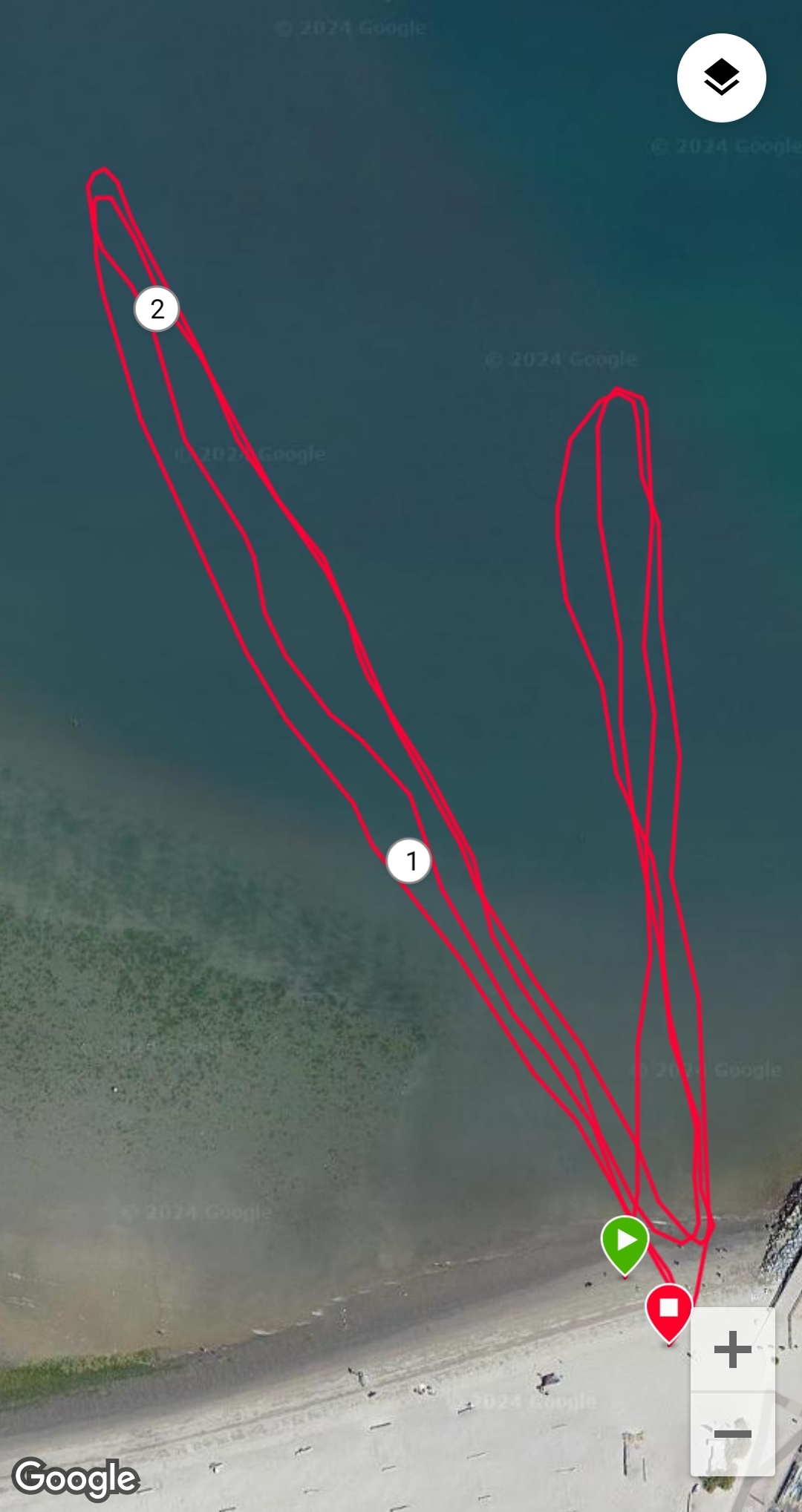
Below is the route that I actually took recorded with a Garmin watch shown on Garmin Connect app and the associated stats summary.

Final Thoughts
Overall, the event was a great experience. My favourite aspect was the technical sprint-style two-kilometre course. The turns and sprint nature of the event suited my SUP style, strengths, and interests. For future races, I will be sure to think about my start position and effort in greater detail and anticipate quick turn around times in multi-course events. I wonder if the standard five-kilometre course with a longer downwind leg would have suited my racing style better too, though I suspect the lighter narrow boards would have been flying. Maybe next year I will get to find out.
 I SUP Explore
One thought on “Vancouver SUP Challenge: 2 KM”