Tuesday, April 1, 12025 Human Era (HE)
- Overview
- Deep vs. Jerry’s Cove
- Flatwater Fitness Assessment
- The Start Shaken Sea
- Do You Draft Dilemmas
- The First Turn
- Shallow Grey Rocks
- Race Results
Overview
Stand up paddleboarding (SUP) racing season is back! The opening SUP race for the 12025 HE Vancouver racing season is the annual inaugural Tuesday Night Race (TNR) organized by Deep Cove Kayak.
The TNR is a paddlecraft-propelled race (it is not just SUPs, but is open to qajaqs canoes, out-rigger canoes, prone paddleboards, and surfskis) that runs every Tuesday from April 1st until September 16th. The race launches from either Deep Cove or Whey-ah-wichen/Cates Park, depending on the week. The 12025 schedule can be found here.
Each week’s race ranges from around 4 to 10 kilometres. Weeks with longer courses also offer a short course option, so there is a race for everyone. The season is also punctuated with two of the Big Three Vancouver SUP races, the Board the Fjord and Whey-ah-wichen Whipper. The third race of the Big Three is the Vancouver SUP Challenge.
April Fools: This Week’s Course
This week’s course was a four-kilometre loop launching from Deep Cove, heading around Grey Rocks Island, before circling back to Deep Cove. Not knowing how traffic would be heading from Vancouver to North Vancouver I left with ample time. Traffic was fine so I arrived with plenty of time to spare.

Sign-in, Warm-up
After signing in, a seamless process once you’ve done one race and have a number, and settling up ($5 CAD – a steal of a deal given the markets), I got my kit in order before heading out on the water for an extended warm-up, the benefits of which cannot be overstated, which I have written about previously.


Deep vs. Jerry’s Cove
Then it was off to the start line, which was slightly busier than my regular racing spot of the Thursday night Jericho Wavechaser with 85 contestants. The Wavechaser out of the Jericho Sailing Centre at Jericho Beach, which derives its name from Jeremiah Rodgers and was known as Jerry’s Cove before getting shortened to ‘Jericho,’ averages half of that.
My plan for this season was the same as last year. Do as many of the early races as possible at the TNR since the Wavechaser doesn’t start until May. I would love to do both, but it is too big of a time commitment with the cross-bridge commute, not to mention that two weeknight races is a big strain on family life.
Flatwater Fitness Assessment
For the last two years, I have been on a fitness kick after a previous philosophy and practice of fitnessing only through physical activity. The distinction is that I see physical activity as movement and exertion that occurs from your daily activities and recreation/play, whereas exercise is purposeful goal-directed physical activity, with the explicit aim of improving health, fitness, or performance. For more topical content, check out this blog series on bioenergetics and metabolism, or this ongoing saga on endurance training philosophy and physiology.
Leading into this year’s SUP season, I had amassed an array of exercise conditioning sessions, ranging from riding, rowing, running, and, of course, SUP. Needless to say, I was curious to see the fruits of my labour, and a flatwater race was as good a venue as any. The conditions were less likely to influence racer speed, something that I welcomed from a fitness gauge but would hinder my relative performance.
Already, I had seen changes in my riding FTP, fitness watch VO2max estimate, and running fitness and performance. How would these changes pan out on the water, where the environmental conditions make relative changes harder to quantify. Paddling one section of water one day is rarely the same the next, particularly on the ocean where wind and current are constantly changing.
The Start Shaken Sea
The sit-down paddlers are the first wave of racers followed by the SUPs. As the signal sounded for the SUPers, we set out into the now unsettled, storm-like sea. That’s a bit of an exaggeration, but the previously smooth waters had definitely been stirred by the seated paddlers. With our wakes now adding to the waviness, I witnessed one rider to my right side succumb to the sea seeded shakiness. He was riding an NSP board (I noticed since it is the same brand as mine, and I had eyes it up for purchase when it was listed on the SUP used boards for Sale Canada site). While we were warming up earlier, another rider asked me if I had just purchased my board from the seller. Since I was familiar with the board and seller, I was able to recognize the board and figured it was the rider getting used to the narrowness of his new Ninja.
Do You Draft Dilemmas
As the draft trains began to form, I wondered where I should position myself. In hindsight, my recurrent race regret reared in repeat. I didn’t go fast enough out of the gates in an attempt to not overextend myself at the start. Now, there was no way to be with the lead group, though I’m not sure that is a train I could maintain. The result was that I found myself in limbo. Sure, I could tag onto on train and save energy in the middle pack, but I was worried that I’d be losing speed doing so. Drafting in a short course, I’ve come to realize, is only ideal if you are following someone that is slightly faster than you. This allows you to paddle at a faster speed for less or the equivalent energy output. Drafting will save you energy as well if travelling behind a slightly slower paddler, but I now believe this is only beneficial in a longer course where fatigue factors of slower onset (e.g., temperature, hydration, fuel, etc.) are factors.
The conclusion was that I chose to go it on my own. The decision was twofold. First, I would be able to go at my own pace. Second, since I was using the TNRs as early training runs for the Wavechasers, I might as well get the full fitness load rather than offset my work with drafting.
The First Turn

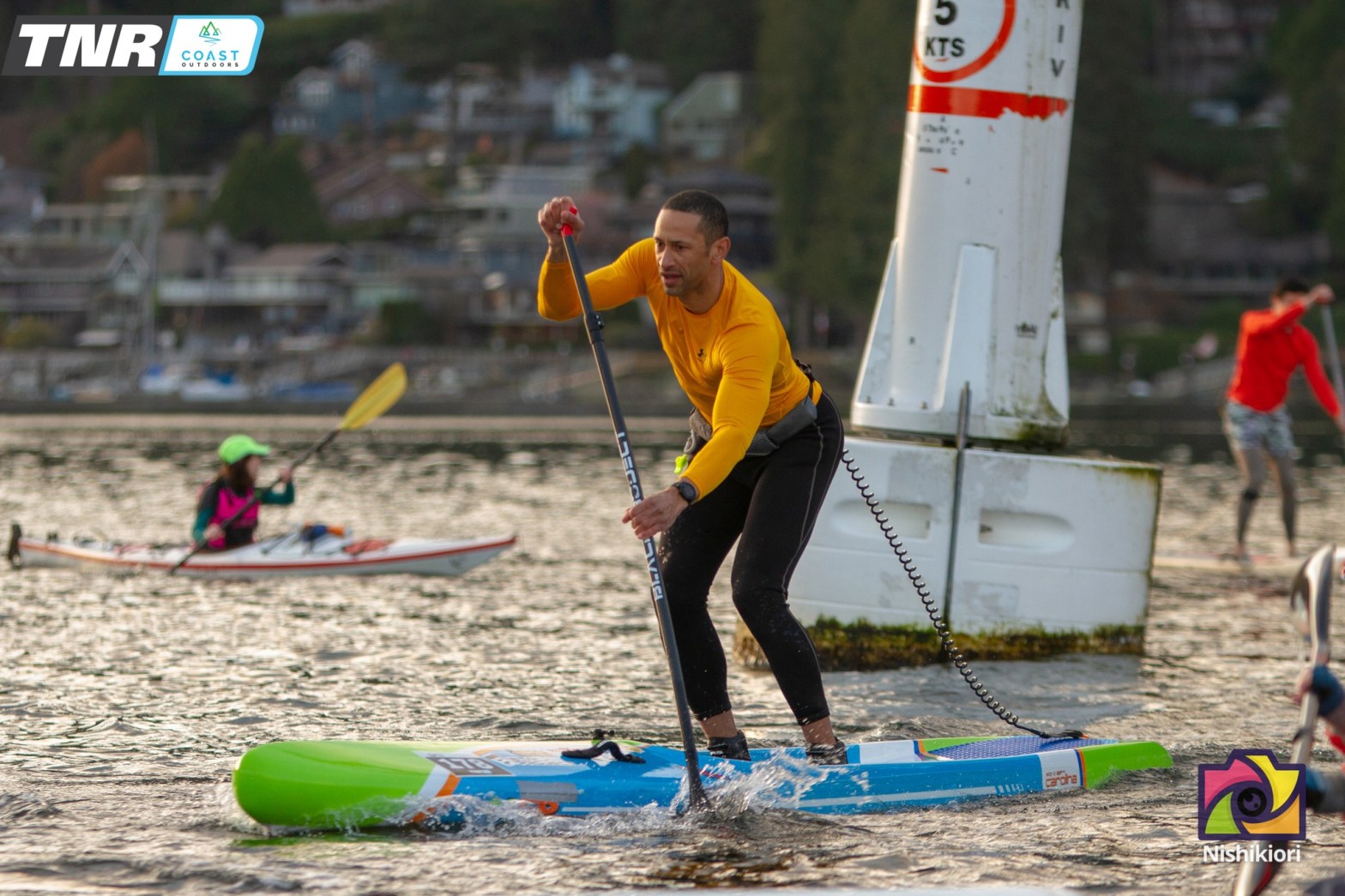
The first turn was a starboard one around the speed marker at the south side of the bay. Approaching the corner, I was part of a party of paddlers, two to three other SUPs, and a host of qajaqers. Approaching the buoy, I made my way to the inside line, hoping for a tight and fast pivot turn. Given that the corner was shaping up to be a hectic one, I accelerated, hoping to get a lead into the turn. Realizing I had made my move too late, I slowed down. There was no way to safely speed into the turn, but I did have the inside line on the other SUPers. I stayed tight behind one of the qajaqers and managed to get through unscathed, sticking to the shoreline inside route and pulling ahead of the closest qajaqer. The other SUPers had gone wide to the outside of the qajaqs. I took advantage of the situation and tried to push ahead.
Shallow Grey Rocks
Jockeying for position and trying to find the faster water, I found myself drifting from the shoreline side to the channel side as we past Cove Cliff. Now that I was in line for a tight port side turn around Grey Rocks Island, I made a conscious effort to stay even closer to shore. It proved to be a nearly fatal decision.
I have been around Grey Rocks Island enough times to know that the western shore has some shallow sea boulders. But in the heat of competition, I overlooked the difficulty of spotting them at race pace. Especially in the fading evening westward sunlight. With a canoe to my right, my paddle made contact with a denser than water, but still soft yet gritty substance. As my brain processed what had happened, the retroactive recalculation of my feed-forward motor plan had bubbled into consciousness. Or at least that’s what it felt like as I hesitated to make my next move. I was just putting the pieces together that I must have hit bottom with my paddle and was now at risk to hit my fin when I felt my fin make contact. Thankfully, it was either shallow enough to be a grazing, soft enough to not matter, or I had slowed and steadied myself enough to maintain my balance that my fin contact happened without incidence. The canoers beside me either heard it or saw me falter, as they asked if I just hit in slight disbelief that I was still standing. Still in slight disbelief myself, I refocused on the paddleboarders I had been pursuing and paddled on.
Rounding the southeast edge of Grey Rocks Island, or more specifically, White Rock, I was less cavalier with my corner. The film crew boat was set up here, and I managed to cut the clip below from the race summary media.
Once on the east side of the islands, it was a straight shot to the end of Cove Cliff before an easy left turn into Deep Cove. We would be on the tail-end of the fastest section of the flooding tide going by the rule of thirds. Staying closer to shore, I was hoping to catch some faster water. In theory, the main body of water through the channel would be moving northward fastest in the centre where the channel is deepest. But somehow, I had convinced myself that there would be some eddies closer inland to boost my progress. Upon reflection, I am nearly certain this would have been impossible, a fact that is only made worse since I should have known better after recently reading Tristan Gooley‘s “How to Read Water.”
After the corner around Cove Cliff, I set me sights on a paddler ahead and tried to reel them in (à la Cosby before he became a controversy). It turns out I would come up short of a photo finish, but I was encouraged by my efforts with my fellow paddler acknowledging that he heard me coming, but that if there was a longer distance to go, he would not have been able to fend me off. As encouraging as that was, I am not sure that would have been able to keep up my pursuit intensity over a longer distance, either. I suppose future races may reveal the answer to our feigned failures.
Race Results
In the end, I managed a sixth place finish. I was happy to be in the top 10, but a higher finish would be welcomed. Initially, I thought my time of approximately two minutes and twenty seconds off of the top time was a significant improvement. But after checking last year’s results, it is in about the same ballpark. I guess I will have to wait for some of the bigger race events to see how my times are stacking up this season.
 I SUP Explore