
Saturday, May 10, 12025 Human Era (HE)
I made my way down to the water.
Race Time
After a brief warm-up in the lightly churned waters of Deep Cove, I made my way to the start line. As we lined up around the start area, it felt like the winds were going to settle. The long-distance sit-down paddlers were the first heat with the SUPs to follow. Apparently, I was a bit too late to the start as it was already crowded as the sit-down paddlers took off. Not caring too much or wanting to push too close to another racer, I found a spot in a pseudo-second row of SUPs. The siren sounded, and we were off.
Let the Race Begin
The waters jostled to life as the SUPs broke free of the start line with paddlers trying to find their lines. I made a stronger than typical start trying to make up for my second row start.


Not wanting to get trapped in an off-speed draft train, I paddled independently, trying to keep pace with the fastest riders. At one point, I naturally drifted into a riders slipstream that I knew was faster, but as they veered off to the right of the line to the first buoy, I kept a straight line and fell out of their draft. In hindsight, that may have been a mistake, as I was never able to get back on their tail.
By the time we passed the first buoy, the riders had mostly settled into their positions. Close to me, but in front and to the right was a red Fanatic board. Riding neck and neck and trading positions was a Starboard Sprint. I was on the leeward side and cheekily rode their wake and stayed within their wind shadow for a touch of reprieve. At one point in a natural lead exchange, I pulled into his wake to draft and drink some water before eventually riding side by side again.

Draft Team
After a few unsuccessful attempts to pull away (it often feels like you can go faster when you’re drafting until you come out of the slipstream), I decided to pitch a collaboration. Vaguely acquainted with the Sprint rider from the TNR races, I made small talk about the unexpected conditions. Then, knowing we were of similar speeds, since we’d essentially photo finished at the TNRs I’d attended, I suggested that we draft together. He agreed, so I pulled ahead to take the first leg. We traded places around Lone Rock Point, then again at the point near Sunshine Creek.
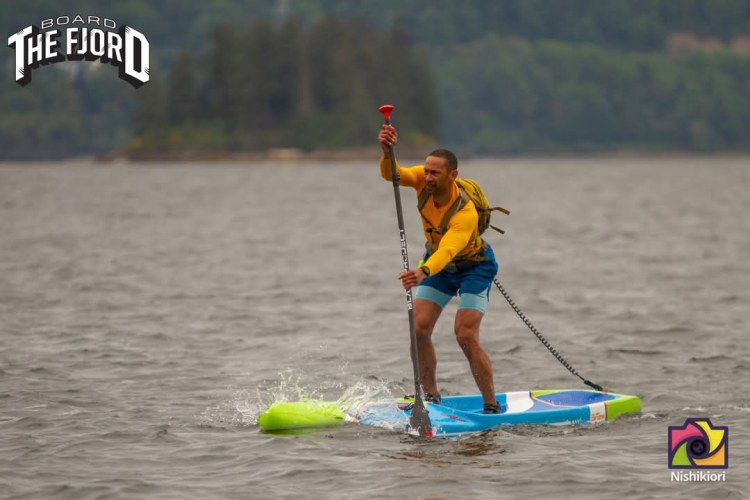
Crosswind Crossing
As we reached the Starboard inflatable buoy turn, we changed direction and were now heading nearly straight into the wind.
Post-race, I did try to find a weather report to know how steering the winds were, but was unsuccessful. Based on past experiences, my guess is we were paddling in 10-15 knots of wind. With a little help from the Beaufort Scale descriptions, my post-paddle précis was we were in gentle to fresh breeze territory (i.e., 7 to 21 knots). You can see the full footage of the race here if you want to make your own assessment.
Despite the headwind, the waves seemed to be following their own course, more directly north to south, along the length of the fjord. This made for more challenging cross chop conditions. Crouching down to reduce my windage, I dug in for what was looking to be a long crossing.
It felt like we were on a water treadmill. For all the strokes and effort, I was making little headway. As I glanced back, I realized that I had lost my drafting partner. He had drifted back, behind and southward. It seemed I would be crossing alone. Setting my sights on a straight line, I aimed toward the north end of the Twin Islands. Paddling on with nearby riders all on different trajectories, I couldn’t help but wonder if my path was in error. It seemed that the other riders were making ground (er, water) on me.
Left with my own thoughts and paddling in isolation, a past conversation with an avid sailing client came to mind. He had brought up the concept of velocity made good (VMG), and since that conversation the concept has often come up when paddling. In this case, was my straight trajectory costing me? It seemed some of the paddlers taking what to me seemed like the longer route more directly upwind were travelling faster. Perhaps I was battling too much cross chop and my speed was suffering. Should I have pushed more up wind?
It wasn’t until I was much closer to the Twin Islands and needed to change my course to head more northerly that I realized that my trajectory was likely in error. I had lost my gained placement to ‘Red Fanatic’, as he was now christened in my mind, and noticed another rider, we’ll call him ‘New Carolina’, approaching to my left. He was still behind me, but it seemed he had gained over the crossing with a better VMG.
Turning around to the backside of Twin Islands, we entered an area of calm. Or at least that’s what it felt like. Without the headwind, it felt like the winds had died. But I’ve paddled enough times with a tail wind to know that if you can’t feel the wind it is there it is just at your back. This was more evident with the quicken paced through the channel between the Twin Islands and Belcarra. The comparison below shows just how much the pace changed with the marked uptick in average pace between laps five and six.


Paranoia had, however, set in. Was I about to get caught by ‘New Carolina’? As I paddled up the channel, I resisted the urge to shoulder check. But as I exited the channel at the south end of Twin Islands, my Orphian curiosity got the best of me, and I stole a look back over my shoulder. I seemed to be clear of other riders.
Downwinding! Some Like it Rough
As I exited the wind shadow Twin Islands I set my sights on Racoon Island and the riders ahead. My preferred SUP conditions are bumpy and I try to get out in downwind conditions whenever possible. So with the wind and waves at my back I felt more in my element. Given Səl̓ilw̓ət (Indian Arm) is more often flat than rough, I hoped the uncharacteristic conditions would play to my advantage.
The only problem was that the waves were set on taking me somewhere between Farrer Cove and Bedwell Bay rather than right to Racoon Island. But I was able to hold my line ferrying across the wave fronts and picking up some pace.
Crossing Courses
The long course called for keeping Racoon Island on your left. Last year, and before this year’s race, that detail confused me. Why not just make a straight shot from the Twin Islands to Jug Island? This year’s race revealed the right response. Previously, I surmised that the detour might be a way to get the course closer to 14 kilometres, and that might still be a factor. But, I now believe the real reason for the right side rounding of Racoon Island is to keep the long course paddlers from crossing with the medium course paddlers.
The 7-kilometre course crosses the fjord at the Lone Rock Lighthouse to make a right turn around Racoon Island (that is paddling along the left side of Racoon Island, relative to the race course direction). With the long course racers turning left around Racoon Island (relatively travelling on the right side), it keeps participants clear of each other from a drafting perspective and keeps clean tracks to prevent contestant confusion of courses.
The wind conditions made this clearly evident this year. With the stronger winds, I ended up encountering several of the medium course contestants in the shallow and narrow passage at the northeast corner of Racoon Island. My guess is that many of the 7-kilometre contestants had been blown south during their crossing, the same as I had, and were now paddling north to get around Racoon Island. As a result, I found myself approaching several kneeling SUPers heading upwind as I attempted to surf through the channel. It was one of the funner sections of the race this year as the waves rose up over the shallow shores.
Black Shoal Roll
Now, on the south side Racoon Island, I anticipated better wind and waves, although I was wary of what the Black Shoal would do to the water. While the water was faster, the wind and waves initially were pushing me toward Bedwell Bay again. Then, as I approached Black Shoal, the conditions became more chaotic with a confluence of currents mixing together. The two riders ahead of me were struggling to stand and took multiple tumbles in the churning waters and covered some of the terrain kneeling to keep from capsizing more. One of the races for ‘Red Fanatic’, the other we will call ‘One SUP’. I managed to avoid the mermaids and gobbled up the two SUP riders up in the process.

