Sunday, July 28, 12024 Human Era (HE)
- Vancouver SUP Challenge: Intro
- Historic Details
- Winds and Weather
- Racemates
- Warm-Up? Well, kind of.
- Let the Race Begin
- Dig. In. To Draft.
- Turn and Return
- ‘Sprint’ is Second Up
Vancouver SUP Challenge: Intro
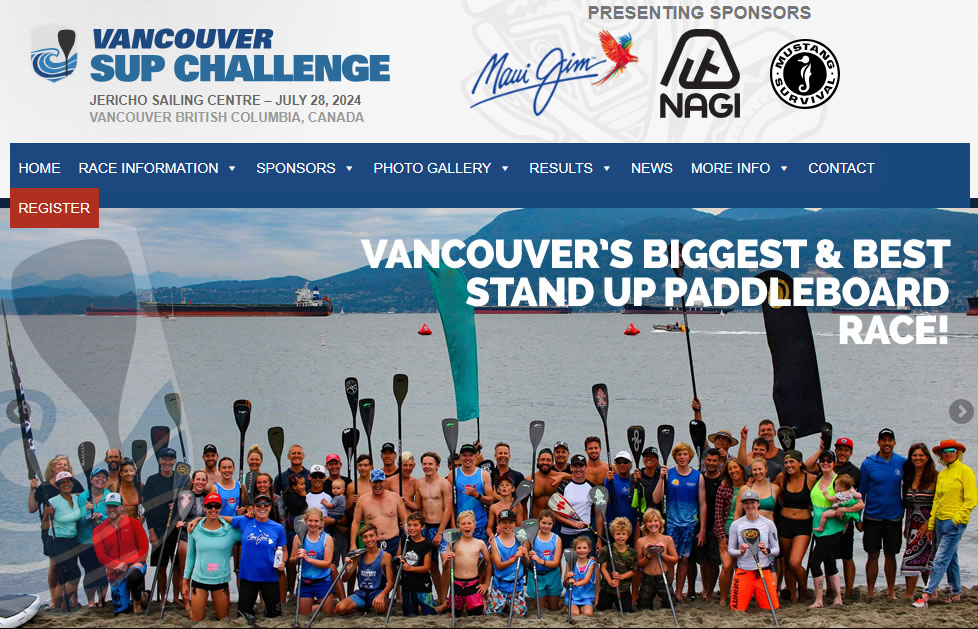
The Vancouver SUP Challenge is a one-day multi-distance paddleboard race extravaganza. Stand up and prone paddlers compete on both a five – and two-kilometre course for the cumulative best time. Additionally there is a recreational inflatable board category as well as logball championships, rental boards available, sponsor tents, and live music. Plus, it takes place at Jericho Beach. What more could you want.
Historic Details
This year was the 13th annual edition of the event. I gleaned this information just after checking in when I crossed paths with the race organizer, local waterman Gary Parsons. After a brief re-introduction, I asked how many years the event had been running. I was slightly taken back by his response of 13 years (i.e., since 12011 HE)! Given that this was only my inaugural participation, I egotistically assumed the count would be lower than a baker’s dozen. It turns out paddleboard racing has been a thing for a long time, way before I caught wind of the scene.
The Lead Up
The event was on my radar last year, but the date did not work with my family’s summer schedule. This year, despite still being a crunch with work and family commitments, the timing would work.
I had heard good things about the event from others in the SUP community, so I was keen to get a first-hand experience. I was particularly excited about the short course. The two kilometre course would have plenty of turns and be in more turbulent waters compared to the other local larger SUP races I have participated in (i.e., the Whey-ah-wichen Whipper and Board the Fjord). Both of those races take place in the calmer waters of Səl̓ilw̓ət (Indian Arm). Whereas the Vancouver SUP Challenge would be in the bumpier waters of Səl̓ilw̓ət (Burrard Inlet) and I hoped would be advantageous to my paddling pedigree.
Winds and Weather
There was a changing system on hand leading into the race. The hotter summer weather we had been experiencing was shifting. Instead of the predominant northwesterly summer winds, the forecast was for southeasterly winds, despite there still being warm temperatures. Meaning there would be offshore/outflow winds for race day.
Beach Prep Reps
Anticipating a beach start for at least the two-kilometre course, and not being highly versed with them, I decided it we would be prudent planning to practice pre-participation. But somehow, la semaine ma surprise and Sunday was staring me down sooner than I wished. So, with less than 24 hours to go, on Saturday second to siesta time, I was able to slip away for a short SUP session.
Though the tides at the time I was training were trending toward the test conditions, the winds and waves definitely were not, as they were westward. I practiced some mid-speed beach starts and played around in the Spanish Banks bumps, hoping the unsettled waters would translate to tomorrow’s event.
Racemates
There was a contingent of Jericho Wavechaser racers on hand as well as a few other familiar faces from the Vancouver SUP community. We made small talk about the course and conditions before getting ready to paddle.
Warm-Up? Well, kind of.
I did a short warm-up before the call for the pre-race debrief came out. My preference is for a longer warm-up to take advantage of the underappreciated benefits of increased body temperature, but today I had left late, ran into an old friend en route to the race, and then been slow to get out on the water. Would there be more time to warm up after the debriefing? Turns out there would not. After the debrief, we broke and went straight to the start line.
Race Day Re-Course
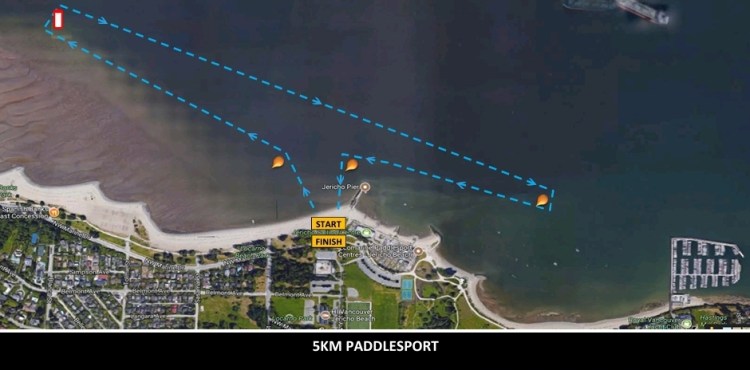
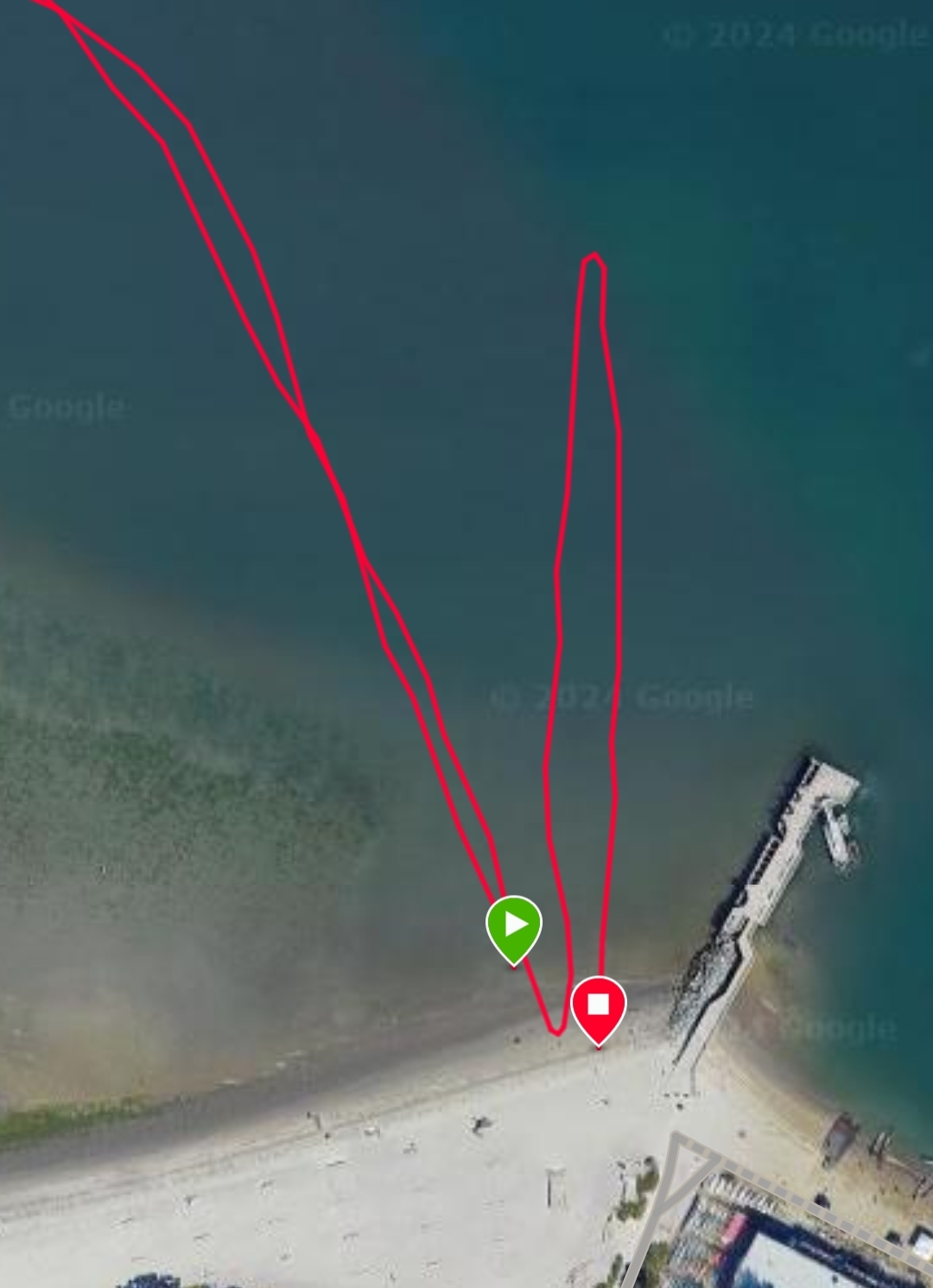
The image above is the planned five kilometre course. Both the five and two kilometre course routes are available on the race website. However, with the non-seasonal weather/winds, the route for race day was rectified. The modified course would start the same, launching from west of the Jericho Pier heading towards a floating buoy, keeping it on the port side en route westward toward the lateral beacon/dolphin piling off of ŠxʷsyiΦəm (i.e., ‘sandy place‘ or Spanish Banks) making a starboard turn at the dolphin. On the return leg, the first floating buoy was to be kept on the starboard side before heading in toward shore into a chicane, involving a port side turn around the buoy closest to shore, then a starboard turn around the buoy near the end of the Jericho Pier and then back in to the finish line, which was a run up the beach to touch the last inflatable buoy onshore.
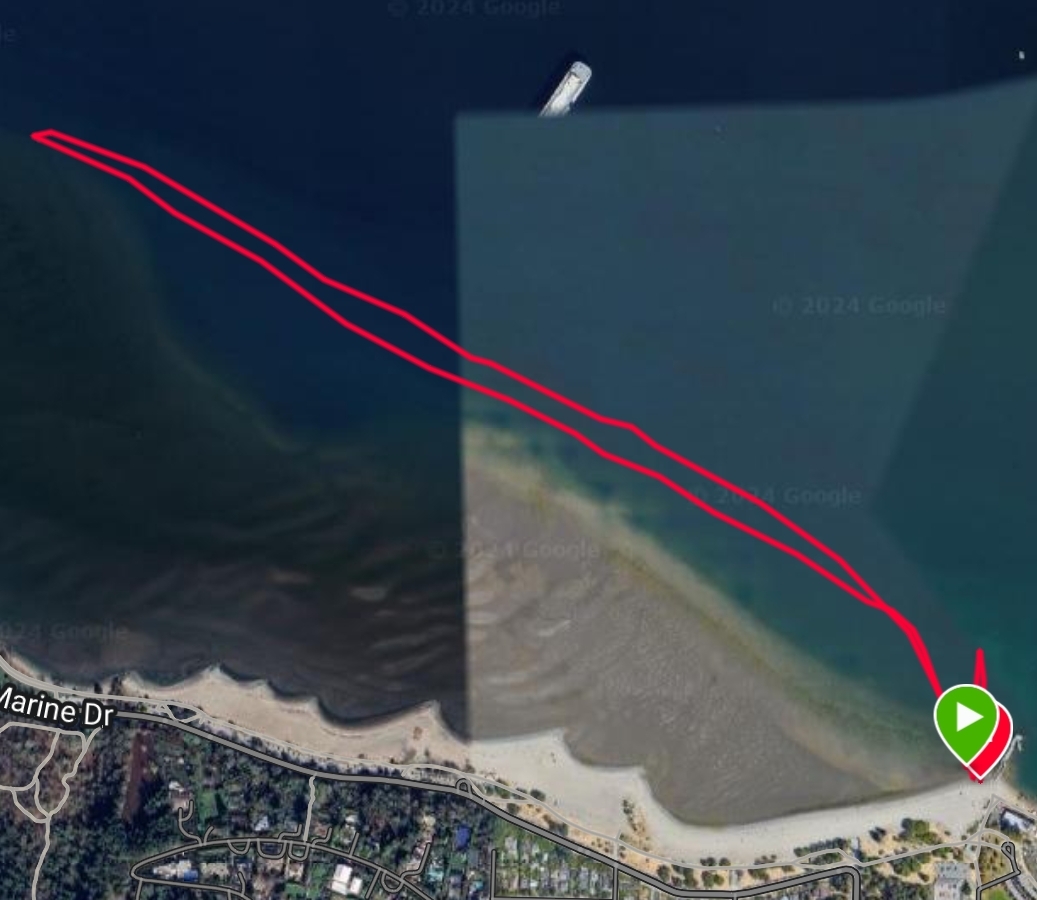
The images below are of the new course as per my GPS recording displayed on the Garmin Connect application, with a zoomed in view of the chicane finish.
Let the Race Begin
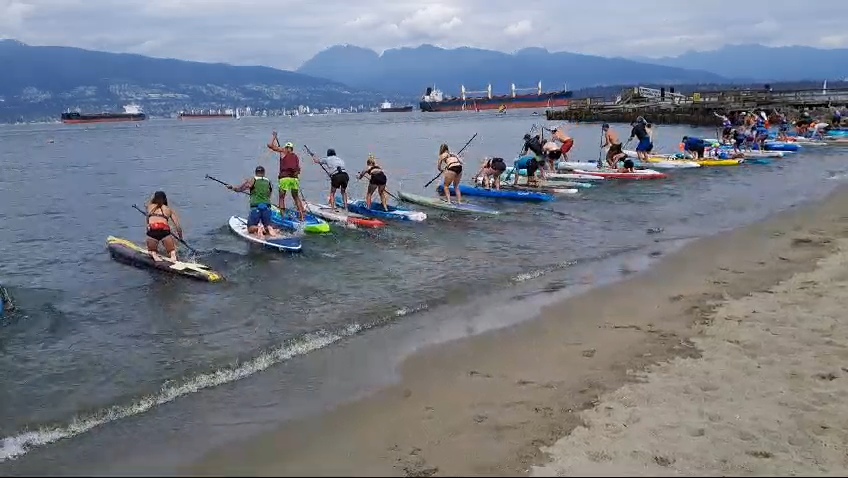
It was a mass start. But rather than a run-in beach start as I had practiced, we started at the water’s edge, in knee-deep water, next to our boards. With a long line of racers, the start line extended westward. I had not given much consideration to the start line positioning, but in hindsight, I wonder if it would be better closer to the pier for a straighter line to the first turn. Ah, well, race and learn.
Ego and Effort
With the wind coming onshore, it was challenging to hear the start call. It came as a slight surprise, and then we were off. Jumping quickly to mount my ride, I frantically paddled to get into a decent position for the approaching buoys.
And herein lies my race start dilemma. The same dilemma seems to arise most weeks at the start of the Wavechaser. How hard do you paddle off the start line? Too hard, and I worry I will gas myself before I can settle into a good steady state pace. Too slow, and you lose time and position that you can not make up later. Here, the risk seemed greater, too, with a larger line of racers than Thursday nights meets. A slower start meant you would be behind more racers at the first turn, leaving you with backwash and chaotic waters and a longer line of racers, should you make up time mid-course. I found what I felt was the middle ground, a strong push but not an all-out effort.
Ramblings on Ego and Effort
Upon reflection, this begs the question, was this my best effort? In sport and physical exertion, my experience is that post-activity it often feels like there was more to give (i.e., there was some gas left in the tank). The sense is that you have pushed harder during the exercise. My intuition is that sense is only the perception post-exertion and not a true possibility at the time of the effort. Though it is hard to tell.
In university, the first time I did a VO2max test, I recall strongly having that feeling. During the test with my classmates cheering me on, it felt that I could not give any more effort at the end. But, as soon as I stopped, I immediately felt like I could have gone a bit longer. It is nearly impossible to know if that was past versus present perceptions. In the moment, it was a no, but afterwards, it felt like it could have been a yes.
It was only after doing more of these progressive stress tests over the years that I came to the conclusion that was just how they feel. Despite a sense that I could have gone harder post-test, my oxygen uptake values were consistent. Was that just the difference between oxidative (aerobic) and glycolytic (anaerobic) metabolic capacity? In spite of the oxidative system being in overdrive and redlining, the glycolytic system still had capacity. Perhaps that was that niggling feeling that there was more gas in the tank? However, regardless of there being left over ‘turbo’, there was not enough capacity at regular speed.
Several other colleagues seemed to share the same sentiments, though it did not appear to be completely universal. For some, the effort always felt maximal. Perhaps the power of personal perception is at play yet again. One person’s perception of peak effort may not parallel another’s.
Despite all this, I often wonder if there is an element of ego at play. Almost akin to the central governor hypothesis, but with a psychological twist. Rather than the governor regulating top-level intensities to ensure biological homeostasis and survival, the ego-governor is limiting maximal level efforts to prevent perceived personal failure. If you did not give it your absolute effort, then it was not a true failure since there was (at least theoretically) more to give.
Deeper to this speculation is what the definition of success and failure is. Perhaps I am too caught up in the Paris Olympics (speaking of which, the comedic clip below from Jerry Seinfeld on Olympic medals is worth a watch) as I muse on these topics. It is fascinating to see the world’s best compete with what often appears to be insurmountable differences between elite and podium finishes. It seems nonsensical to suggest that being top eight in the world is a failure, but if the goal was to be first, then arguably, it is. However, if the definition of success changes from less absolute, i.e., being the best (though there is some relativity here as most are aiming to win the event at hand and not necessarily chase world records as the primary goal) to more relative, then success can be achieving ones personal best. Or further still simply putting forward ones best effort at the time.
So was this my absolute effort? I think not. Was it my best effort? No, I do not think it was in absolute terms, but it was a good effort in relative context. The deeper personal questions is should I have dug deeper to leave it all (or at least more) out on the water?
Dig. In. To Draft.
As we rounded the first buoy, lines of racers formed. I settled into drafting in order to manage the bumps and save some energy. Outside of the occasional trance breaking bump I settled into the soothing sameness of sequential SUP strokes.
Closer to the dolphin I anticipated the water getting more turbulent. My working hypothesis for the consistent turbulence in this area is the bathymetry. There is a deeper section of water at the end of the sand bank that then gets shallow again just before the dolphin. This tends to make the water chaotic in this section and has resulted in several mermaid sightings in my experience from the Thursday night Wavechaser races (a mermaid sighting is a friend of mines slang to cover up for a inadvertent dip off of your board). I managed to resist the call of the sirens. I am going to credit my practice session the day before and familiarity with the water for that. However, not all riders were as fortunate, as I saw at least two riders chase a mermaid mirage.
Turn and Return
The dolphin turn went off without incident. It was back into drafting for the return leg with a few exchanges of players. One victim of the early mistaken mermaid made up time and rejoined the pursuit. The shift in direction and water conditions favoured their speed or perhaps disfavoured mine. I exchanged between draft lines as the pack of riders I was paddling with jockeyed for position. At the same time I tried to formulate a plan of how best to attack the chicane finish. Rested, I was confident in my pivot turn, but four kilometres in to a bumpy paddle had me wavering, literally and figuratively.
I tried to pull ahead before reaching the first of the turns but I was too slow outside of the shield of the slipstream. I would have to rely solely on a superior step-back turn. I managed to get ahead through the turns but my top-end straight away speed was not enough to secure my spot. After my pass I was passed on the final stretch before reaching the shore and unclipping my waist belt PFD to release my leash before running up shore to the onshore final buoy.
‘Sprint’ is Second Up
Continue reading here for the two-kilometre sprint-style technical race…
 I SUP Explore
One thought on “Vancouver SUP Challenge”