
Saturday, May 10, 12025 Human Era (HE)
Spring has sprung, and it is time for the first of the Big Three SUP races in Vancouver, Board the Fjord! The other two races of the Big Three are the Vancouver SUP Challenge and the Whey-ah-wichen Whipper.
This is my second time competing in the Board the Fjord. If you want some of the background regarding the event, as well as some of the basic geology of Səl̓ilw̓ət (Indian Arm) where the race takes place, check out my post from last year’s race. If you just want this years installation, read on.
Forlorn Forecast
At the start of the week, the weather looked okay for the weekend. The forecast wasn’t the summer-like spring sunshine of the past two years for the same weekend, but initially, it was at least sun and clouds. But as the week progressed, the possibility of rain increased, and as of the morning, it looked like it would be overcast skies with some showers. Maybe the race would take place in the window of no rain, but in Deep Cove, that was a big ask, as it is notorious for rain.
On arrival at Deep Cove, I took advantage of the short-term 15-minute parking to drop off my board and sign in. Somehow, I missed the email from the night before with the instructions and deadline (2100 hours) to sign in by text message, only reading it at 2130 hours, so I needed to sign in in person. The waters looked relatively calm at that time. Take note of the foreshadow.
Parking was relatively easy as I found a free three hour spot close by. I suspect the inclement weather was limiting the number of hikers, and paddlers were keen to have longer-term parking to avoid violations. Wanting to stay warm, I took my time getting ready before heading down for the pre-race meeting, but it was 15-20 minutes at most.
Race Wear
With temperatures forecast around 10°C and flat water conditions my plan was to wear athletic wear shorts and t-shirt, along with booties [along with the requisite safety wear of a PFD (inflatable belt pack for me) and whistle attached via spiral stretch keychain for easy access]. Though I did consider wearing an athletic wear long-sleeve top given, it felt cooler than forecast. Voicing my consternation around coolness and clothing to another paddler parked posterior to my plot, she suggested the advice of a friend who must run warm. His advice/motto was to ‘be bold and start cold.’ While I understood the rationale, as I’ve had many an overdressed overheating in either a drysuit or neoprene, somehow that mantra didn’t sit right with me. The quote below came to mind, but I wanted a shorter rhyming rebuttal.
Remember: It is much better to be on land and say to yourself “I wish I was on the
“Overnight Rentals.” Bowen Island Sea Kayaking, 10 May 2020, https://www.bowenislandkayaking.com/newsite/wp-content/uploads/2020/04/self-guided-multi-day-trip-questions.pdf.
water” rather than being on the water and saying “I wish I was [on] land!”
Perhaps more pertinent is the paddling proverb of dressing for immersion, that is, to dress for the water temperature, not the air temperature.
Nevertheless, nothing came to mind in the moment, other than a mumbled mention of what if you freeze. It was only later that a suitable rhyming response came to mind. Something along the lines of ‘wear a long sleeve to avoid a sneeze and a freeze’ or ‘better to be fraught with being hot than to feel like a fool too cool’. More on this later.
In any case, I stuck with shorts for my bottoms, kept my t-shirt on, but contemplated the long-sleeve alone or underneath the t-shirt, with a distant third option being my neoprene long-sleeve shirt. My worry with two layers was that if it rained (or I capsized), I’d be waterlogged. With the pre-race meeting approaching, I put on over layers and then made my way back down to the race base.
Back near the water, as I checked the course map and surveyed the seas in the lead-up to the pre-race meeting, I had second thoughts about my attire. A northeasterly squall had moved into the fjord and was churning up waves with the occasional white crest in the bay and more caps further out in the main body of the arm. The flag banners at the registration tent were now waving in the wind, and the Board the Fjord surfboard trophy even blew over in the gusts. The question now was how long-lived would these winds be? Fjordal flurries can be fleeting.
Pre-Race Meeting
The course direction was going to be the same as last year, with the 14-kilometre long course going in a clockwise direction. This is what I had been anticipating given the forecast for little to no wind and any wind coming from the south. The biggest difference between years was going to be the tide.
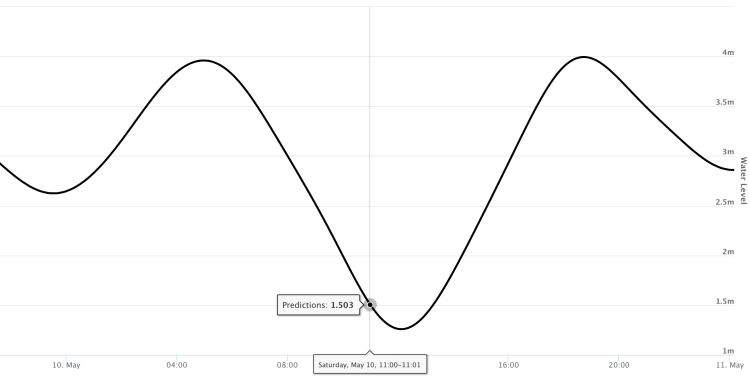
Last year, the race took place through the middle of the ebbing tide, creating celerity of current and chaotic waters in the consequent (i.e., second) channel crossing from Boulder Island to Grey Rocks Island. This year, however, low tide was 1.26 metres at 1208 hours (see the graph below with the vertical line highlighting the race start time of 1100 hours). Thus, by both the ‘Rule of Thirds‘ and ‘50/90 Rule‘, the race would take place during the slack tidal current from 1100 to 1300 hours.
The Long Route: Details
For the long 14-kiliometre course (see green trace below) paddlers leave Deep Cove making a left turn around the speed limit buoy before heading north up the arm, travelling through the channel between Lone Rock Point and Lone Rock Lighthouse, then making a right turn around an inflatable Starboard buoy. Next, paddlers cross the fjord toward the northern end of Twin Islands before turning to head south. On the southern leg, Racoon Island was to be kept on the port side before heading to the east side of Jug Island to make a right turn. Then, it was southbound towards Hamber Island, which was to be kept on the port side before rounding the southeast side of Boulder Island and crossing the fjord once again to Grey Rocks Island. After rounding Grey Rocks Island, the last leg of the course was back to Deep Cove for the finish line.

Omen for an Omission
The route details for all courses were well described, with the exception of one slip up. During the description of the 7-kilometre course, the race organizer momentarily went into the 14-kilometre course after Lone Rock Point/Lighthouse. I only mention this to highlight the brief moment of confusion that was quickly caught and corrected. Let me highlight that if there was any confusion created, it was in the northerly leg of the course, not the southerly side. More on this to come later, as it would seem the course instructions were not entirely clear to all contestants…
Final Clothing Call
Post pre-race meeting, I made my way back to my vehicle to remove my additional layers. The winds had died down slightly, and there was no rain at the moment, so my final clothing call was to wear sports shorts and a long-sleeve top. My rationale was that I would be working hard and likely wasn’t going to get cold. The great part about the inefficiency of human energy conversion from food sources to useful work is that it is only about 20-25% efficient. Seventy-five to 80% of the chemical energy attempting to be converted to mechanical motion is lost as heat. With extra clothes available post-race, my plan was to stay warm with movement and then get into warm and dry clothes immediately post-race if I happened to be wet/cold from the event.
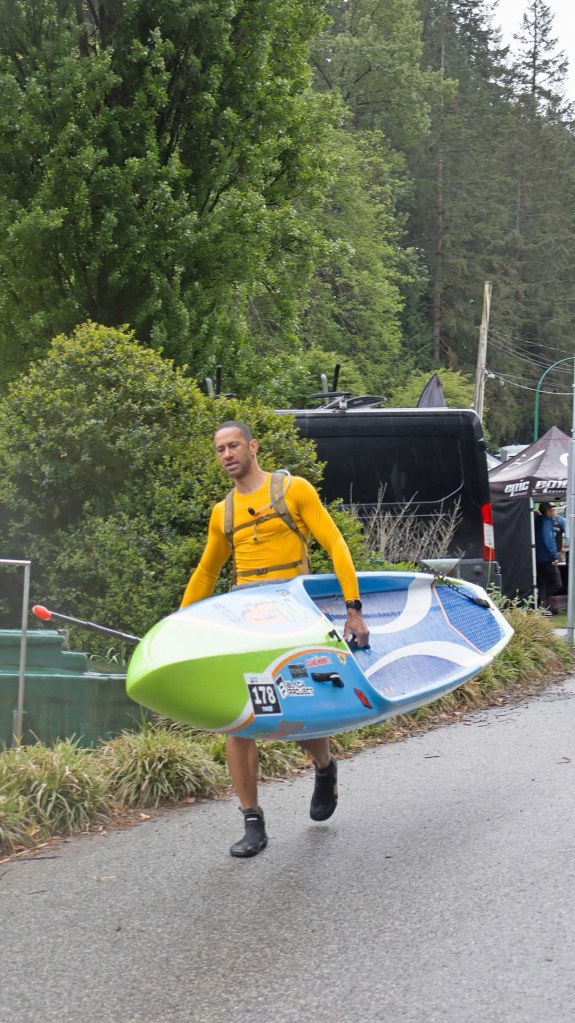
Paddle. Board.
I used my BlackProject Adjustable Lava paddle and rode my NSP Carolina (12020 HE model).
Paddle Length Calculations
Here are some thoughts on paddle length. A while back, I came across an interview with Michael Booth where he mentioned that he sizes his paddle length to his height plus 4%. For me, at 189 centimetres, that translates to 197 centimetres. Somehow, however, I had drifted to paddling with my shaft set to 195 centimetres, likely through some travel where I shortened my paddle to save space and then never put it back to the correct length. Who doesn’t like mid-points on the base ten system? 😉
Ape Index: Arm Span-to-Height
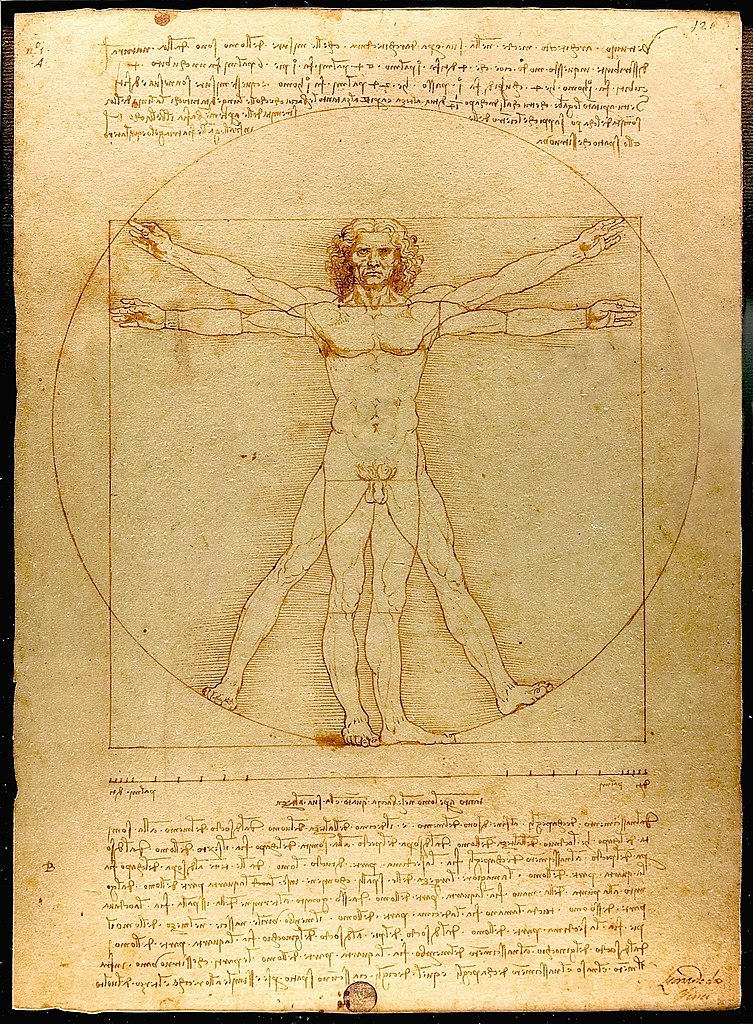
However, after seeing video and photos of myself paddling at the Deep Cove TNRs, I started to question my paddle length. When I revisited the math from above, I realized that my 195 centimetre setting was at least two centimetres too short. On top of that, I have a high ape index or, more properly stated, arm span-to-height ratio. My arm span is 207 centimetres, giving me a ratio of 1.10, well above the assumed population ratio of 1.00, and even above the NBA ratio of 1.06. Given my disproportionate arm span-to-height, I decided to take the average of my height and arm span and add 4%, giving me a paddle length of about 206 centimetres. For my last few paddles, I have used 205 centimetres, and that’s the length that I used for Board the Fjord.

Outside the Box: Bioenergetics and Biomechanics
The proportions of limb segments and body parts are fascinating topics in sports physiology. I have mostly considered it from a biomechanical viewpoint, but recently, I saw a compelling argument explaining some of the factors behind the move towards shorter crank lengths in cycling. While I was vaguely familiar with the condition of external iliac artery endofibrosis, or cyclist’s iliac syndrome, the suggestion that shortening ones crank lengths might lead to less compression of the external iliac artery and possibly less turbulent blood flow, ultimately resulting in better perfusion of the thigh muscles, and perhaps performance, was a titillating prospect. Though, in fairness, this is purely conjecture, as to date, the evidence points more towards performance effects arising from improved aerodynamics and metabolic efficiency by way of factors like faster pedal velocity.
All of these details left me considering the parallels to paddling. For example, how does paddle length affect stroke rate? Does a longer or shorter paddle affect blood flow parameters [I swear none of this is meant to be suggestive, but it sure sounds that way 🤔] through the stresses/strains applied to the thoracic outlet (or superior thoracic aperture)? If so, is it the same for everyone, or do individual morphological characteristics matter? Are the changes meaningful to health or performance? I am still contemplating the possibilities, so don’t expect any insights anytime soon.
I made my way down to the water to warm-up.
 I SUP Explore