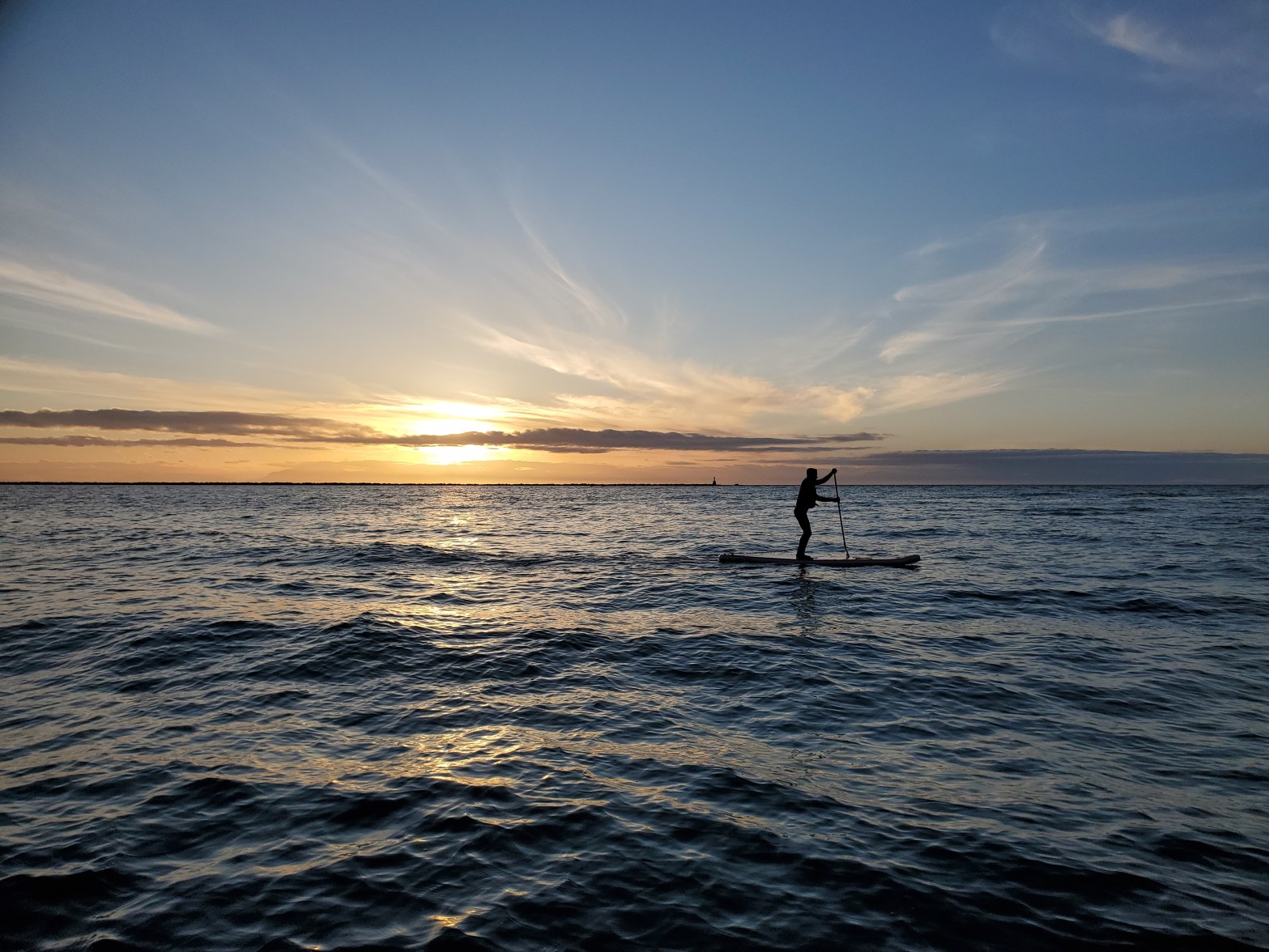
Here are my general rules of safety as well as some specific recommendations if you will be engaging in solo paddling.
As a warning, solo paddling inherently poses some additional risk compared to paddling with a partner, but at the same time, it can be an extremely rewarding experience. For some great views on the benefits and considerations/cautions around paddling solo check out these articles: paddling.com, fitfunsup.com, and islesurfandsup.com.
In general, I think it is always best to go by the adage of plan for the worst and hope for the best.
Remember: It is much better to be on land and say to yourself “I wish I was on the
“Overnight Rentals.” Bowen Island Sea Kayaking, 10 May 2020, https://www.bowenislandkayaking.com/newsite/wp-content/uploads/2020/04/self-guided-multi-day-trip-questions.pdf
water” rather than being on the water and saying “I wish I was [on] land!”
Learn To Swim
To me, swimming is a life skill that should be taught to everyone. I understand that this is an elitist view. I am fortunate enough to be in a place of privilege since I was afforded the opportunity to learn to swim as a child. My mom grew up in what is now the Democratic Republic of the Congo and she did not learn to swim as a child. One of her brothers drowned in his twenties in a fishing accident ostensibly because he could not swim. As a child, I always wondered why he would not have learned how to swim, especially if he was going to get into fishing as employment. The answer I later learned is that there are crocodiles (among other predators) in the local waters. In any case, knowing that being able to swim could have potentially saved her brother’s life certainly played a role in my mother’s desire for her children to learn to swim. My mother, may she rest in peace, learned to swim later in her life, after fifty, and before her passing was an avid aquasizer. So it is never too late to learn a new skill!
If you do not currently know how to swim at a basic level my recommendation would be to learn. It will not only give you an added layer of security but also an extra level of confidence on the water. In the meantime, always use a lifejacket or personal flotation device (PFD) if you want to paddle while you are learning to swim.
Wear a PFD and Bring a Whistle
Even if you can swim, you should use a PFD, most if not all of the time (I say most of the time as there are instances in which paddleboards could be used as a sort of floating dock where a PFD may not be required). In Canada, you are required by law to either wear a PFD with a whistle or carry on board a PFD, a whistle, AND a floating throw rope. In addition “Parks Canada highly recommends wearing a PFD and leash“, “Transport Canada supports leash use, but not as a replacement for life jackets and PFDs“, and “Inflatable PFDs are prohibited for people who are under 16 year of age.” It is worth noting that under the Small Vessel Regulations leashes are not allowed as a replacement of lifejackets and PFDs.
A watertight flashlight is required if the vessel is operated after sunset or before sunrise or in periods of restricted visibility. For all the details, check out the Small Vessel Regulations on Safety Equipment on Pleasure Craft. Parks Canada summarizes the basic requirements here and strongly recommends wearing a leash.
I have both an inflatable PFD and a vest-style PFD (here is Transport Canada’s guide for choosing the right lifejacket or PFD). Both of my PFDs have whistles attached to them.
Rules of Thumb
My rule of thumb is that for any solo paddling, I always wear a PFD. The exception is lake paddling in the summer, in the case where I would be at a distance from the shore where I would comfortably swim to. In this case, I still wear a leash to keep me connected to a flotation device, my board.
If I plan to stay within a reasonable swimming distance of the shoreline then I will generally use my inflatable PFD. However, if I know I will be far from shore (i.e. greater than two kilometers) then I wear my regular PFD. If I am paddling with a partner then I am more likely to just wear my inflatable PFD (though this would depend on their water safety comfort level). Also of note, is that your swimming capacity can change drastically depending on water temperature and this should be consider in your decision tree.
In the case where I am not doing a point-to-point voyage, for example on a lake or staying close to shore in a safe swimming area then I will paddle without a PFD.
Wear a Leash
I think it is a good idea to always wear a leash whenever possible. When SUPing, your board is your vessel. It is your main floatation device. If you are separated from your board, that could spell disaster.
However, I do subscribe to the adage rules are meant to be broken. There are circumstances, for example, whitewater rivers where wearing a leash could arguably pose more of a danger. I, however, do not whitewater SUP, so there are people whose opinion is much more informed than mine on this topic. From my perspective, it is best to have a quick-release style (e.g., this one from Badfish) leash that you could easily separate from if your leash was to become entangled with something and pose a liability to your safety. I do have a quick-release style strap that I can attach to my PFD, but I have rarely used it.
There are two types of leashes and they have different purposes. A coiled leash is generally used for flatwater conditions since it stays out of the water reducing your drag. Though it is also used for downwinding, again for the reduced drag. When downwinding a leash is extremely important because if the winds are strong enough they can easily carry your board away from you should you fall off.
A straight leash is generally reserved for surfing. While the leash does cause some additional drag it is an accepted tradeoff to prevent your board from recoiling back towards you in the surf when you fall off of your board.
This is an excellent vlog explaining the different leash types.
Bring a Communication Device
In case of an emergency, it is important to have a way to communicate for help. Most people have a cell phone and this is an easy way to communicate. But, depending on where you are paddling reception could be a problem. Be sure to consider this. Make sure to pack your phone in a waterproof yet relatively accessible place. I either use a waterproof phone lanyard case, waterproof e-case, or waist belt.
Another option is to use Marine VHF Radio (here is a great overview as to the importance and utility of radio for qajaqers [but it holds for all paddlers] from paddling.com). The advantage of a VHF Radio is that it uses two-way communication that can be picked up in areas that do not have cell phone coverage. Additionally, you can get weather forecast information as well as communications for other marine vessels. This is particularly useful if you are crossing any busy marine passageways. In Canada, you are required by law to have an operator’s license to use a VHF Radio. Courses are available through the Canadian Power and Sail Squadrons (full disclosure is I am currently in the process of completing this course as an online home self-study – yay pandemic!).
One more option is a GPS satellite communicator. These devices use satellites to send messages as well as GPS data. They allow for communication when you are off of the grid, where cellphone communication is not possible since the land-based tower relays do not reach these areas. Essentially, you will have coverage anywhere in the world as long as you have an unobstructed view of the sky. Here is a great post by REI about these types of devices.
Paddle with a Partner
Generally, it is safer paddling with a partner than solo. If something goes wrong, you have someone there who can either directly help or call for help. But there are no absolutes, and a paddling partner could also pose a risk to you if they are unsafe or if the two of you (or a group of you) collectively elect to make (a) bad decision(s). This phenomenon is known as groupthink.
If I am feeling unsure of the conditions that I will be paddling in I will go with a partner. However, in familiar or comfortable environments I will paddle solo for the reasons described in the articles above.
Know the Environment and Know Your Ability
“If you know the enemy and know yourself, you need not fear the result of a hundred battles. If you know yourself but not the enemy, for every victory gained you will also suffer a defeat. If you know neither the enemy nor yourself, you will succumb in every battle.”
Tzu, Sun. The Art Of War. First Thus, Filiquarian, 2007.
Sun Tzu sums it up nicely. Know what you are up against and know what your abilities are. If the two do not add up, then there is the potential for trouble. When you are unsure where you stand regarding your abilities, err on the side of caution. When considering the environment, always think of the Four Ws for watersport safety.
A good way to help you determine your abilities and/or stay within them is to either take a course or paddle with a more experienced partner. Additionally, knowledge is power, and there is ample information out there if you have the willingness and resources to search for it and learn from it.
Dress for the Water Temperature Not the Ambient Temperature
Dress for wetness, not successes. This could be part of the “know the environment” statement from above, but I am giving it specific attention because I am posting this during the winter. You never know when you may take a dip, so it is always important to dress for the water just in case. This is not as much of an issue in the summer or in warmer climates, but it is a necessary consideration for the fall and winter here in the Pacific Northwest. Appropriate clothing could be anything from quick-drying athletic wear (think synthetic fibers for their water-resistant properties or natural fibers, like wool, that is water-resistant due to lanolin oils from the animals that produce it) if there is a low chance of submersion and the ambient temperature is moderate. For colder water and/or multiple plunges, consider investing in a wetsuit or drysuit or semi-drysuit for the colder season or cooler waters. Here are a few links to help you decide which is better for your paddling, keeping in mind that each have their pros and cons: standuppaddleboardworld.com, www.suppaul.com, www.standuppaddleboardingguide.com.
Be Prepared
I grew up going to Boy Scouts and the motto that my dad, who was our troop leader for many years, drilled into us was “Be Prepared.” Simple but effective.
For paddling, this means things like knowing the conditions, planning your route, having a backup plan, bringing the necessary food and water, etc. In addition to all the other points like knowing your ability. To add in another adage, always remember the seven Ps: Prior Proper Planning Prevents Piss Poor Performance.
Provide a Paddle Plan to Friends/Family
This simple act cannot be stressed enough. In the event of a grave emergency, odds are it will be a day late and a dollar short. But for lesser/slower unfolding emergencies it could prove to be the difference between life and death. I always inform someone where and when I will be paddling. Depending on the nature of the paddle I will provide more or fewer details. If it is a quick and familiar paddle I will simply let someone know where and when I will be paddling. For anything more complicated I have the following template that I use both for my planning and as a safety guide should something go wrong. I include all the relevant information for the given paddle. For another sample template, see this one from the Canadian Safe Boating Council.
Paddle Plan Template
DATE: [Day][Month][Date][Year]
ROUTE: [Launch Point][Return Point]
EST. DEP.: [HHMM]
EST. ARR.: [HHMM]
Details:
Tides [Location]
•[HHMM] High [m]
•[HHMM] Low [m]
Current [Location]
•[HHMM] Flood [kt]
•[HHMM] Slack [kt]
•[HHMM] Ebb [kt]
Wind
•Forecast as per Windy.com
•Marine Forecast as per the Government of Canada
•[Direction][Speed in Knots][Wind Gust Speed in Knots]
Sunrise
•[HHMM]
Sunset
•[HHMM]
Paddle Distance [km]
Paddle Time [HHMM]
Drive time:
[Home] to [Destination]: [MM]
Personal Info
•TRAVELLERS: [Number][Full Name]
•VEHICLE: [Colour][Year][Make][Model][License Plate]
•PHONE: [xxx-xxx-xxxx]
Itemized Itinerary
•[HHMM] 🚗 Departure from Home
•[HHMM} 🚗 Arrival at 🛶 Departure
•[HHMM] 🛶 Departure from [Location]
•[HHMM] – [HHMM] 🛶 Arrival at [Location]
•[HHMM] – [HHMM] 🚗 Departure from [Location]
•[HHMM] – [HHMM] 🚗 Arrival at [Location] (2)
•[HHMM] – [HHMM] 🚗 Departure from [Location] (2)
•[HHMM] – [HHMM] 🚗 Arrival at Home
Quitting is an Option
You need to know when to hold ’em and know when to fold ’em. Check your ego at the door. If things do not look or feel right, trust your instincts and fold ’em. You can always play another day if you can leave with your chips.
As a practical example, when planning a downwinding route, be sure to think about some potential exit points in case something should go wrong. Or when touring, have a backup plan in case you run into troubles en route to your destination.
That about sums it up. Safe SUPing!
 I SUP Explore
8 thoughts on “Rules of Engagement”